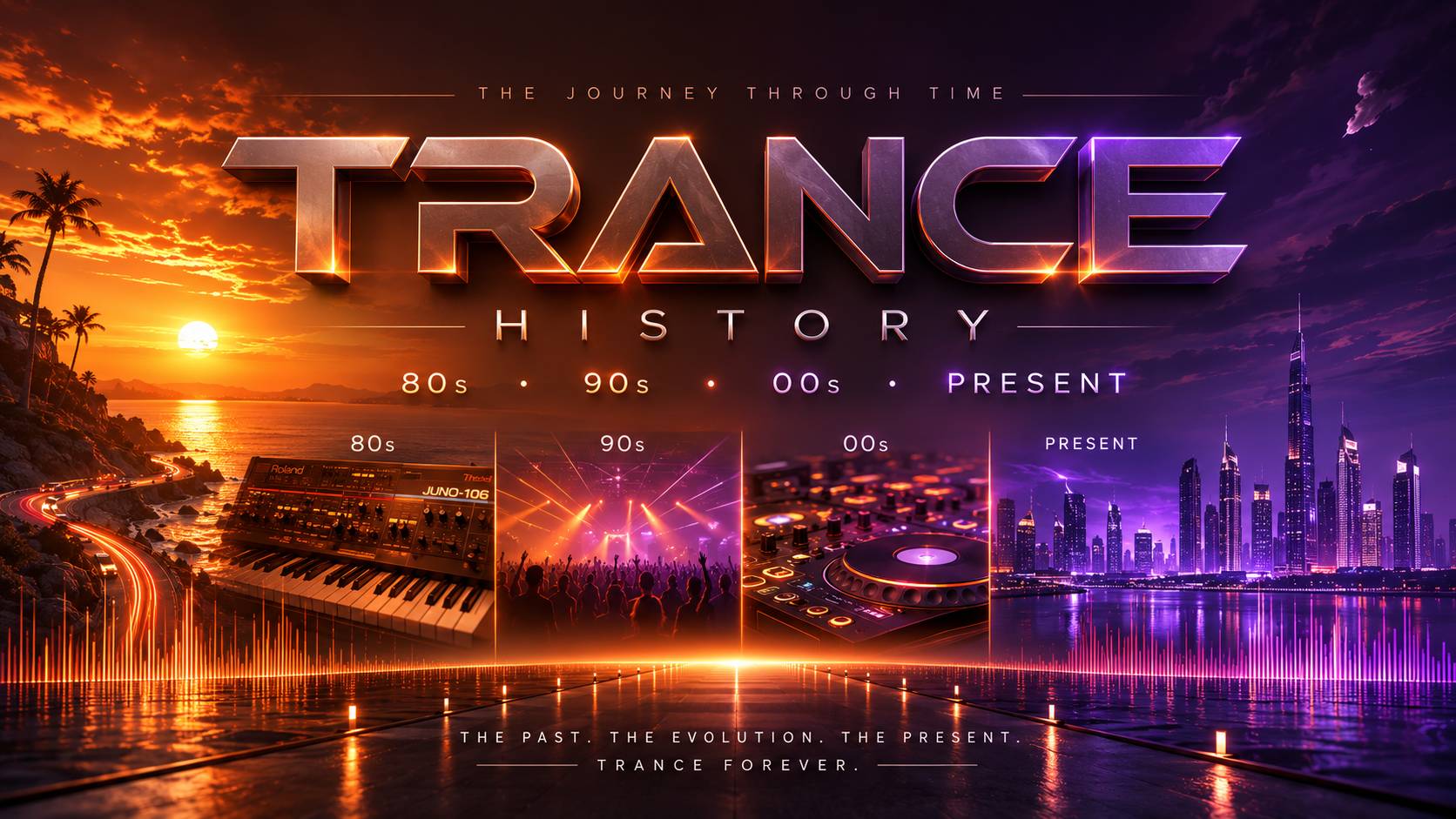
The complete story of trance music
Trance
History
Future
Explore the complete history of Trance music, from Frankfurt’s underground clubs and Berlin’s rave revolution to the Golden Age of Trance, vocal trance, uplifting trance, global festivals, radio shows, podcasts, technology, artificial intelligence and the future of a sound built around emotion.

Master chronology
How the story fits together
Trance did not emerge from one track or one city. These broad eras show how technology, clubs, labels, radio, festivals and communities overlapped across countries.- Electronic foundationsKrautrock, synth-pop, ambient, EBM, house, techno, acid and new beat create the musical vocabulary.
- FormationFrankfurt clubs and labels, Berlin rave culture and Goa’s psychedelic parties help distinct trance languages emerge.
- International expansionEuropean labels, compilations and touring DJs carry melodic and psychedelic trance far beyond local scenes.
- Peak crossover eraAnthems, superclubs, major festivals, specialist labels and global DJs take trance into the mainstream.
- Digital transitionDownloads, forums, radio shows, podcasts and online communities replace many older discovery channels.
- Fragmentation and revivalProgressive, uplifting, tech and psychedelic scenes grow through dedicated events and loyal communities.
- Archive and streaming eraCatalog rediscovery, streaming, social platforms and independent curators connect classic records with new listeners.
- Editorial outlookThe final chapter separates documented history from clearly labelled predictions about technology and community.
Editorial note: Period boundaries are approximate. Musical scenes overlap, and historians often disagree about the exact first trance record or single birthplace.
Introduction
More Than Just Electronic Music
Ask ten people what trance music is, and you’ll probably get ten different answers.
Some will tell you it’s about massive melodies and emotional breakdowns. Others will point to hypnotic rhythms, uplifting energy, and unforgettable moments on festival dance floors. Some will remember late-night drives with headphones on, while others will think of packed arenas filled with lasers, flags, and thousands of people singing the same melody together.
The truth is that trance has always been difficult to define.
Between underground culture and global entertainment. Between technology and human connection.
More than thirty years after its emergence, trance remains one of the most recognizable and influential genres in electronic music. It has survived changing trends, shifting technologies, and multiple waves of commercial dance music. While countless genres have appeared and disappeared, trance continues to attract dedicated fans across every continent.
Its story is not simply the story of a music genre. It is the story of communities, clubs, cities, festivals, radio shows, record labels, and generations of artists who believed that electronic music could be emotional without losing its energy.
To understand where trance is today, we need to return to the beginning.
Before Trance
The Electronic Revolution of the 1980s
Like most genres, trance did not appear overnight.
Its roots can be traced back to several musical movements that emerged throughout the 1980s.
Electronic Body Music, synth-pop, acid house, Chicago house, Detroit techno, Belgian new beat, ambient music, and early rave culture all contributed pieces of the puzzle.
Artists such as Kraftwerk, Jean-Michel Jarre, Tangerine Dream, Front 242, and many early electronic pioneers demonstrated that machines could create emotional experiences. At the same time, clubs across Europe were becoming laboratories for new sounds.
The foundations were in place. What nobody realized at the time was that a completely new genre was beginning to form.

Germany
One of Trance Music’s Principal Birthplaces
No single country can claim every root of trance, but Germany was one of the principal places where the genre gained a recognizable identity.
Frankfurt’s club and label network, together with Berlin’s post-wall rave culture, gave early electronic experimentation the infrastructure to become a lasting movement.
The late 1980s and early 1990s were a period of enormous change. The Berlin Wall fell in 1989. Germany was being reunified. A generation of young people suddenly found themselves living in a completely different world.
Music became one of the most powerful forms of expression during this transition.
Two cities played particularly important roles. Frankfurt. And Berlin.
Frankfurt became closely associated with early club sounds and labels, while Berlin’s open spaces and post-wall energy accelerated rave culture. Their roles overlapped, and both cities remain central to the history of German electronic music.
Reference: MOMEM on the OMEN Club and German UNESCO Commission on Berlin techno culture.
Frankfurt
Where Trance Found Its Identity
For many longtime fans and historians, Frankfurt is one of the central birthplaces of early trance music.
The city became one of Europe’s most important electronic music centers during the late 1980s and early 1990s. At the heart of this movement were clubs that would later achieve legendary status.
Unlike traditional clubs, these venues encouraged long musical journeys. DJs were not expected to play quick hits. They were expected to tell stories.
Sets often lasted for hours. Music evolved gradually. Energy rose and fell naturally. This environment became the perfect testing ground for what would eventually become trance.
Producers and DJs pushed beyond existing house, techno, EBM and new-beat structures, emphasizing atmosphere, gradual development, melody and hypnotic repetition. The vocabulary later associated with trance was taking shape.
References: MOMEM’s OMEN archive and DJ History’s Dorian Gray feature.
Pioneers
The First Trance Pioneers
One of the most interesting things about early trance is that none of its pioneers were trying to invent a genre. They were simply experimenting.
Many of the artists who later became known as trance pioneers were originally associated with techno, rave, ambient music, or electronic experimentation.
Names like Sven Väth, Cosmic Baby, Jam & Spoon, Dance 2 Trance, Resistance D, Oliver Lieb, and Paul van Dyk helped establish the blueprint.
Early tracks often sounded darker than modern trance. There were fewer breakdowns. Melodies were subtler. The atmosphere was mysterious and hypnotic.
The goal was immersion. Listeners would become lost inside evolving layers of sound.
Many historians point to tracks such as “The Age of Love,” “We Came in Peace,” and early Jam & Spoon productions as important milestones.
Berlin
Berlin and the Post-Wall Rave Explosion
Berlin contributed a different but equally important part of the story: a rapidly expanding rave culture shaped by reunification, temporary spaces and new social freedom.
After the fall of the Berlin Wall, the city experienced a cultural explosion unlike anything Europe had seen before. Entire neighborhoods transformed. Unused buildings became temporary clubs. Illegal parties became common.
Electronic music became closely associated with the city’s post-wall sense of possibility and with spaces repurposed for new forms of club culture.
Reference: German UNESCO Commission, “Technokultur in Berlin”.
Love Parade
The Event That Changed Everything

No discussion about trance history is complete without mentioning Love Parade.
What began as a small political demonstration in Berlin in 1989 eventually became one of the largest electronic music gatherings in history. Millions of people attended during its peak years.
Love Parade was not exclusively a trance event. Techno, house, rave, hard trance, and many other styles were represented. But its influence on trance culture cannot be overstated.
Entire streets became dance floors. Music became visible. Electronic culture became global.
The first Love Parade took place in Berlin in 1989 as a political demonstration with roughly 150 participants. Its language of peace, unity and public celebration later echoed through electronic music communities worldwide.
References: Berlin.de, German History in Documents and Images and Rave The Planet’s parade history.
MAYDAY
MAYDAY and the Rise of Mega-Raves

While Love Parade represented freedom in the streets, MAYDAY represented the power of indoor electronic events.
Founded in 1991, MAYDAY quickly became one of Europe’s most important electronic music festivals. For many fans, attending MAYDAY felt like entering the future.
MAYDAY helped establish the large-scale indoor rave as a recurring part of European electronic culture. The official archive dates the first event to December 14, 1991, at Halle Weißensee in Berlin, with about 5,000 visitors.
Reference: Official MAYDAY 1991 archive.
Goa
The Parallel Evolution of Trance

While Germany was shaping one version of trance, another branch was developing thousands of kilometers away.
In Goa, India, a unique electronic movement emerged during the late 1980s and early 1990s. Unlike the industrial environments of Frankfurt and Berlin, Goa offered beaches, spirituality, psychedelic culture, and international travelers searching for alternative experiences.
The music reflected this atmosphere. It was faster. More psychedelic. More experimental.
- Complex synthesizer patterns
- Psychedelic textures
- Spiritual themes
- Long evolving arrangements
- Altered states of consciousness
Goa trance developed into the broader psychedelic trance ecosystem, carrying the full-moon-party tradition into international scenes, labels and festivals.
Academic reference: Giorgio Gristina, Etnográfica, 2019.
1998 to 2005
The Era Many Fans Call the Golden Age

“Golden Age” is an editorial label rather than an objective boundary, but many longtime fans use it for the period from roughly 1998 to 2005, when trance achieved exceptional club, chart, radio and festival visibility.
Everything seemed to align perfectly. Technology had improved. Production quality reached new heights. The global audience was growing rapidly. Artists were pushing creative boundaries.
Classic Track Vault
Listen deeper into trance history
These records are part of the DNA of Trance. Each card gives readers direct search links to YouTube and Spotify.Labels
The Labels That Built an Empire
Behind every great musical movement stands a network of labels that help shape its identity. During the early 2000s, several labels became instrumental in defining the sound of trance.
Vocal Trance
The Rise of Vocal Trance

As trance continued evolving, vocals began playing a larger role. Many foundational records were primarily instrumental, leaving melodies, textures and long arrangements to carry the emotional message.
That changed when producers started collaborating with singers and songwriters. Suddenly, trance wasn’t just emotional. It became deeply personal.
A State of Trance
A State of Trance Changes Everything

In 2001, Armin van Buuren launched a radio show that would eventually become one of the most influential platforms in dance music history.
Week after week, listeners discovered new releases from around the world. The official ASOT history dates the first episode to 2001 and describes the show’s later expansion into a label and event series.
Reference: Official A State of Trance history.
Essential Trance Links
Artists, labels, videos and culture points
A curated guide through the names, labels, tracks and events that shaped the story of trance.The architects of the sound
These names shaped the bridge between underground club culture, melodic trance, festival anthems and the global Trance Family.
Global weekly rituals
Radio shows helped make trance international before playlists and streaming fully took over.
Where trance becomes real
These events show why trance is not only a genre, but a culture built around shared moments.
Connect history with your own world
. It should lead naturally into your own archive, your podcast, your playlist and your long-term contribution to uplifting trance.
Modern Era
The Return of Authentic Trance Culture

The early 2010s brought major changes to electronic music. EDM exploded worldwide. Festival culture became increasingly commercial. Big room house dominated main stages.
For many longtime fans, this period felt uncertain. Would trance survive? Had its golden years passed?
Trance never disappeared. It simply returned to what it had always done best.
Podcast Generation
Uplifting Trance Sessions and Long-Form Journeys

The podcast era has played an important role in keeping trance culture alive.
Among the many projects contributing to this movement are long-running shows dedicated entirely to uplifting trance.
One example is Uplifting Trance Sessions with DJ Phalanx.
2026 to 2040
The Next 10 to 15 Years of Trance

Sources and editorial method
How this history was researched
This page combines documented dates with DJ Phalanx’s editorial interpretation. Official event, institution and label sources are prioritized. Where music historians disagree, the text avoids presenting one disputed origin story as settled fact.Dates, founders, event origins and institutional recognition are linked to official or academic references.
Terms such as “Golden Age” and assessments of musical impact are clearly presented as interpretation rather than measurable fact.
The 2026–2040 chapter is explicitly separated from the historical record and labelled as a scenario-based outlook.
Readers, artists and labels can report factual errors through the contact page.
- MOMEM, Museum of Modern Electronic Music.“OMEN Club Frankfurt 1988–1998 – New Electronic Ecstasy.”Open source
- DJ History.“Classic Clubs: The Dorian Gray, Frankfurt.”Open source
- German Commission for UNESCO.“Technokultur in Berlin.”Open source
- Berlin.de.“Loveparade: 25 Jahre dancing on the street.”Open source
- German History in Documents and Images.“Commercialization of the Love Parade.”Open source
- MAYDAY.Official event archive for MAYDAY 1991.Open source
- Giorgio Gristina, Etnográfica 23(1), 2019.“From Goa to Rabin Square: notes for a research on the uses and meanings of psychedelic trance music and parties in Israel.”Open source
- A State of Trance.Official brand and radio-show history.Open source
- Armada Music.Official company history and founder information.Open source
- Black Hole Recordings.Official label history.Open source
- Anjunabeats.Official label history.Open source
- Rave The Planet.Parade history from Love Parade to the present movement.Open source
References last checked: .
Final Thoughts
And the Story Continues
The story of trance music is ultimately a story about connection.
From the underground clubs of Frankfurt and Berlin to the beaches of Goa. From the massive crowds of Love Parade and MAYDAY to modern events such as Luminosity, Dreamstate, Transmission, and A State of Trance.